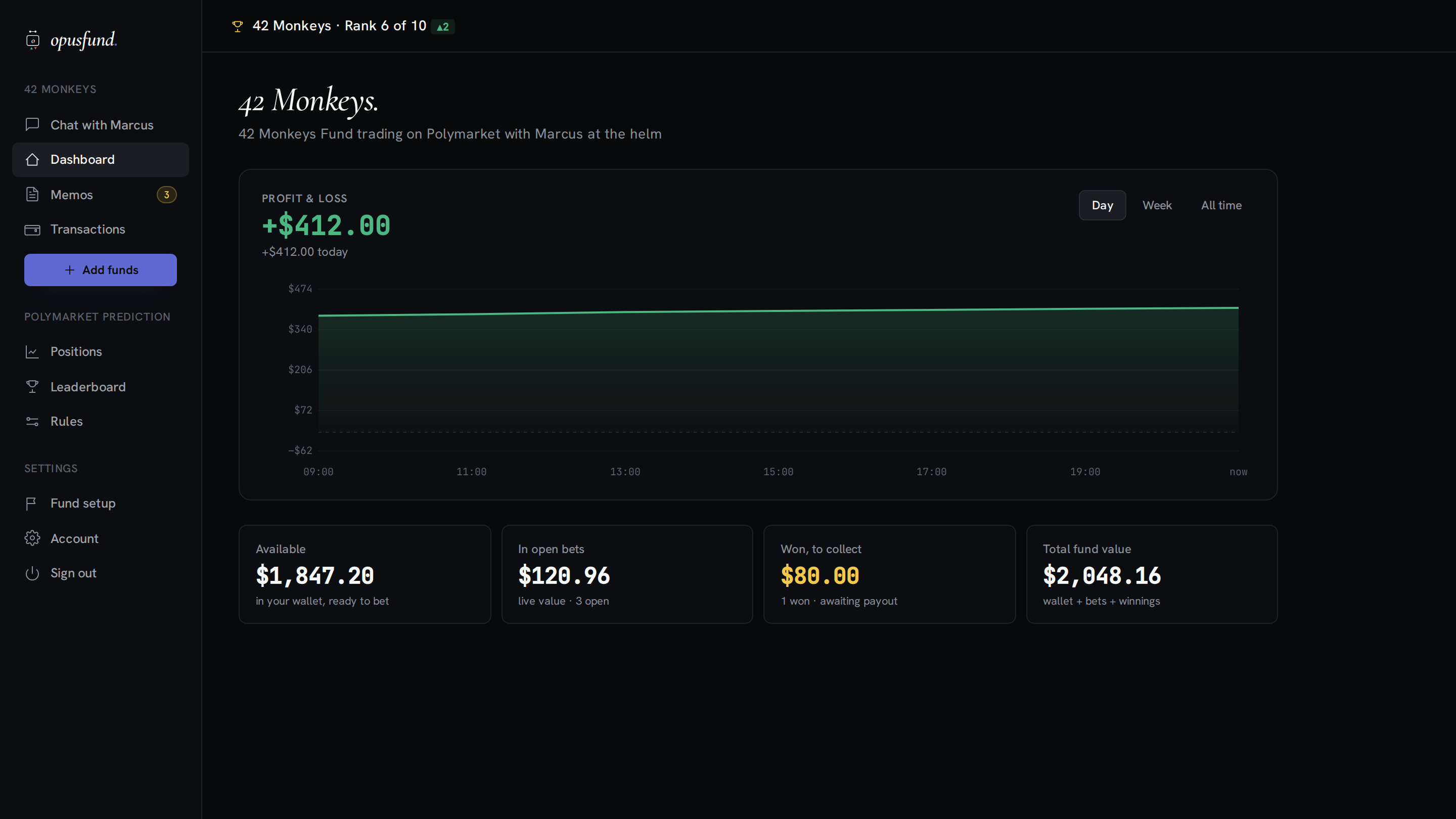
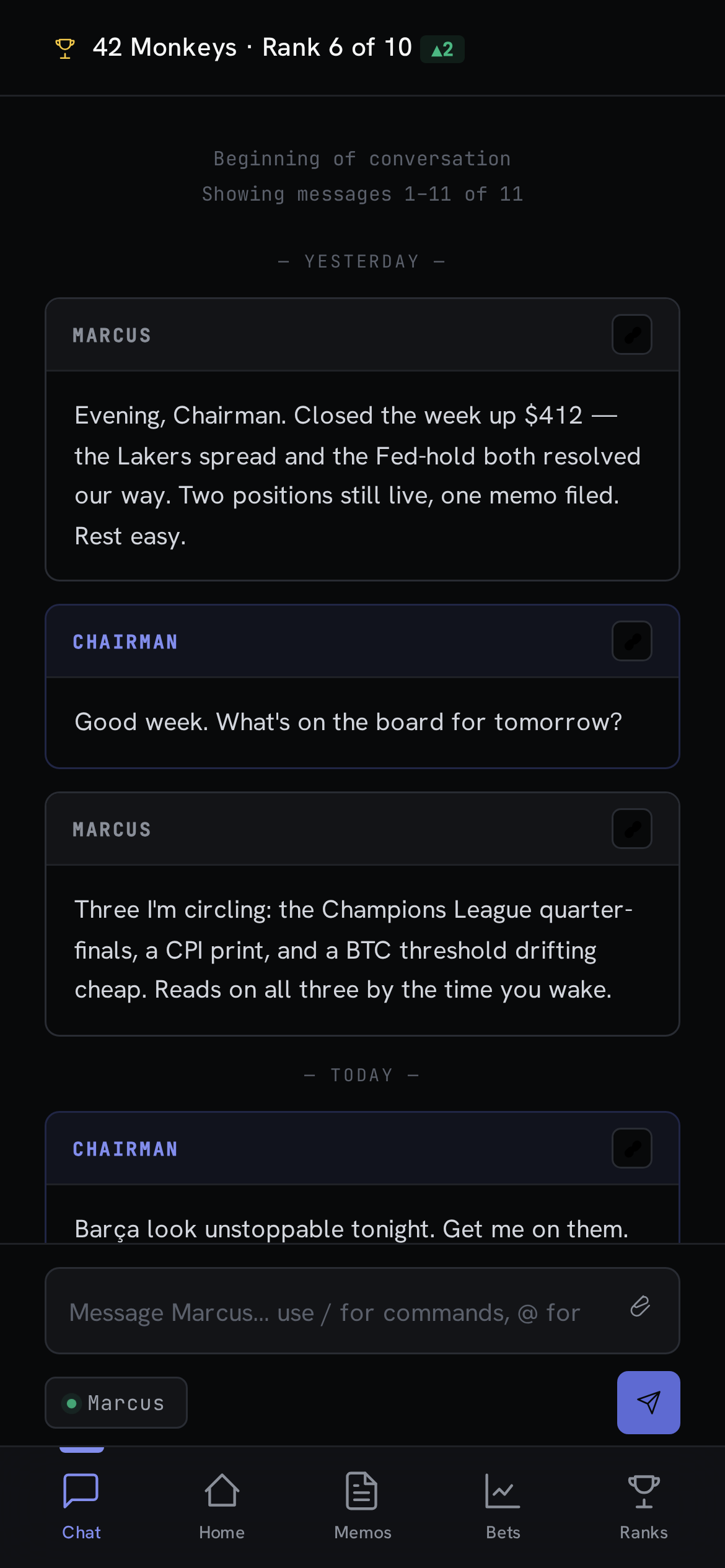
Founding beta — testers start with a 20 USDC welcome bonus

You're the Chairman.An AI runs your fund.

Opusfund is your hedge fund on Polymarket — where people bet on real-world events, from elections to football. You set the rules; the AI researches and places every bet for you.

Opusfund can never touch your money You never place a single bet yourself A clear report after every cycle
Illustrative, not live performance
How it works

Three moves, and the fund is live.

No charts, no timing. You set the rules; the AI does the rest.

STEP 01

Set the rules

Name your fund, pick its markets, and set two limits: the most it stakes on any single bet, and the most it can have riding across the fund at once. That's the whole rulebook.

Politics · Sport · Crypto · the Economy · Tech
STEP 02

The fund runs itself

From there it works on its own, in cycles — one cycle is a single round of research-and-bet. No bet is ever placed by hand.

Runs on its own
STEP 03

See results. Adjust.

Every cycle ends with a clear report — what it bet, and what it won or lost. Want it to work differently? Adjust the rules, and the next cycle follows.

A clear report after every cycle
The fund

Everything the fund does.

Here's how your fund is built — every part of it, in plain words.

Opusfund
Inside the fund
Every rule your fund follows — in plain words you can read, and change as you learn.
Your moneyWhen you onboard, your fund gets a wallet of its own — created in seconds, and non-custodial: only you can open it, and Opusfund can never touch what's inside.
The teamA team of AI agents runs it. An Analyst researches each market you pick and proposes the bets; a single CEO checks every one and decides. The agent that wants a bet is never the one that approves it.
The limitsTwo limits keep it safe: a ceiling on any single bet, and a ceiling on everything the fund has riding at once. The CEO blocks anything that would break either one.
Placing betsThe CEO places every bet itself, straight from your wallet. No Polymarket account to open, nothing to connect — and you never place a bet by hand.
After the betThe CEO sees every position through to settlement — closing what no longer makes sense, redeeming what wins, and sending the proceeds back to your wallet. Automatically.
Your reportEvery cycle ends with a short report — what it bet, what it skipped, and how you're doing. The fund even grades its own past bets.
The guide

How to start an AI hedge fund.

The full guide, in five memos — what you set, how the firm works, and how to run it from the Chairman's chair.

FAQ

Questions, answered.

The opposite. Every rule Opusfund follows is plain text you can open and read — nothing is hidden. And you don't only read those rules, you can edit them: tuning the rules yourself is exactly how you improve your fund and sharpen its agents over time.
The beta runs inside an AI coding assistant — Claude Code or Codex — with no monthly subscription. The hosted version is the opposite: a one-click web app with nothing to install — Opusfund wires up the trusted third parties that run it for you, for a monthly subscription. Both charge the same per-trade fee (0.5% maker, 1% taker). Hosted opens shortly after the beta.
Yes — a small fee on each trade the fund makes on Polymarket: 0.5% on maker orders, 1% on taker orders. A maker order rests on the book first; a taker order fills one already sitting there. In plain numbers, a $100 maker trade carries a $0.50 fee and a $100 taker trade carries $1.00. It's taken on each trade, so it always shows up in your cycle report. This is how Opusfund earns during the beta, where there's no monthly subscription. On the hosted version, the same trade fees apply on top of a flat monthly cost.
No. Your fund gets its own wallet and places every bet itself — there's no Polymarket account to create and nothing to connect. It just works, and your money never leaves your wallet.
Yes — betting carries risk, and the AI can be wrong. The safety net doesn't depend on it being right: the fund sizes each bet on its merits, but no single bet can ever cross the ceiling you set — and everything it has riding at once stays under a second ceiling. A bad call stays small. Only bet what you're prepared to lose.
You do — always. Your fund gets its own wallet, and only you hold the keys. It's non-custodial, which simply means Opusfund never holds your money and cannot move it. The CEO trades from the wallet, but only on Polymarket — it's designed to buy and sell there and nothing else. You fund the wallet yourself, by sending USDC (a digital dollar, always worth $1) to its address on the Optimism network — and you can withdraw it whenever you like. The setup guide walks you through every step.
Claude Code or Codex — the AI assistant the beta runs in — and the money you want the fund to bet with. The rest is guided: you complete a short onboarding, the installer hands you a ready-to-run package to open in your assistant, and from there your CEO walks you through every step, in plain conversation.
Every founding beta tester starts with 20 USDC — a digital dollar, always worth $1 — credited to their fund's wallet at onboarding. It's real money: your fund can bet it from its very first cycle, and whatever it wins is yours. One bonus per Chairman, for as long as founding beta seats last.
Pricing is announced at launch — expect the price of a streaming subscription. That monthly cost covers the hosted setup that runs it all for you — the research, the agents, the execution, and your reports — wired up through the trusted third parties Opusfund connects. It includes enough cycles for the fund to run about once a day, and you can add cycles anytime. On top of that, the same per-trade fee applies as in the beta (0.5% maker, 1% taker). The beta has no monthly cost because you run it yourself — the subscription is only for the hosted version.
Thesis

Today predictions. Tomorrow, all markets.

The hedge fund used to be a place. A building full of analysts, traders, risk officers, and a wall of screens. To run one you needed capital, a license, and the right last name. The barrier was never intelligence — it was the operating stack.

That stack now costs almost nothing.

An Analyst is an AI agent. A CEO is an AI agent. The desk is plain text you can read and rewrite. The guardrails are many and named. The Chairman — the one who sets direction and reads the reports — is you. The fund you can run today, alone, from a quiet room, was a hundred-person operation a decade ago.

A fund that runs itself doesn’t just save you time — it does the things you would never have done by hand. It places the bet you would have hesitated to take. It holds through the day you would have panicked. It tries the small experiment you were curious about but never had the discipline to run. The Chairman commits to ideas. The fund commits to executing them. The gap between knowing and doing — the gap that breaks most traders — is the gap the agents close.

Then there is the part no demo can show: the strange pleasure of watching it work. You read the dossiers your Analyst builds. You see the bets your CEO approved, and the ones it sent back. You watch what the week won, and what it lost. The fund grades its own work, cycle after cycle — every success teaches it, every loss does too. You sharpen what hits, retire what doesn’t, and slowly — in a way no spreadsheet could show — the fund becomes distinctly yours.

We are starting on Polymarket because it is the right first room. Every market is a real question. Every price is a real probability. The resolution is written in the rules, not in someone’s quarterly opinion. A new fund needs a clean place to learn its hands.

But the architecture has no allegiance to one room.

An Opusfund will not live in one room. It will live in many at once. One Analyst hunting a mispriced election market. Another reading a lending pool to see which dollar earns the most this week. A third watching a derivatives market for an opportunity too clean to ignore. A fourth reading the rules of a new market the day it opens, looking for the gap before the crowd shows up. Every room with its own edge. Every edge with its own Analyst.

And the rooms speak to each other. When the prediction desk wins on an election bet, the profits don’t sit — they flow into the base the Chairman has named: Bitcoin, a yield-bearing dollar, an index of crypto. When an event on the calendar looks promising enough to deserve more, the fund borrows against that base to put more on the line. When edges go quiet for a week, capital migrates into yield until they come back. Every win compounds the next round. The Chairman never trades. The fund never sleeps.

This is the bet behind Opusfund: that the next generation of personal finance will not look like an app you open to tap a buy button. It will look like an institution — quiet, plain-spoken, autonomous — running itself for you, in your name, awake while you are not.

Today, one room.Tomorrow, the whole house.

Opusfund

Keep going

You have the why. Next, the room we start in: how Polymarket works, in plain words.

Next · Learn
How Polymarket works
The market your fund trades, followed through one football match from start to finish.
Learn

How Polymarket works

Opusfund places its bets on Polymarket. Before you set a single rule, it helps to know what that is — in plain words, with one football match followed all the way through.

01

A place to bet on real life

Polymarket is a website where people bet on questions about the real world — who wins an election, whether a team wins on Saturday, whether a price climbs past a number by a certain date.

There are no stock charts to read and no finance background to have. If you can answer one question — do I think this will happen? — you already have everything you need to follow along.

One thing to set straight first: here, a market is not a company you own a slice of. A market is a question.

02

Every market is one question

Each thing you can bet on is called a market — and every market is a single question with a yes-or-no answer that the future will settle.

Take the one we'll follow for the rest of this page: Will Brazil win Saturday's match? Right now, nobody knows. On Saturday, everybody will. That stretch — between now and the answer — is the market.

Other markets work exactly the same way: Will this candidate win the election? Will this coin pass $100,000 before July? A clear question, and a date when reality answers it.

03

The price is the crowd's odds

Here is the one idea that makes everything else click.

Every market has a price — a number between 0 and 1, easier to read as 0¢ to 100¢. That price is simply what the crowd betting on it currently believes the chance is. (Its odds — just another word for how likely something is.)

If Will Brazil win? sits at 0.70, the crowd is saying: about a 70% chance. A price near 1 means the crowd is almost sure it happens; near 0, almost sure it doesn't; near the middle is a coin-flip.

0.70
00.501
0 means the crowd is sure it won't happen, 1 that it surely will — and our match sits at 0.70.

And the price never sits still: every new bet nudges it. It is the crowd thinking out loud.

04

What you actually buy — shares

When you place a bet, you buy shares of one answer: Yes, or No. A share's price is that same 0-to-1 number, read in cents.

So if Will Brazil win? is trading at 0.70, one Yes share costs you 70¢.

Now the rule that makes it pay. When the match is over and the market settles, every share of the correct answer is worth exactly $1 — and every share of the wrong answer is worth $0. Nothing in between.

A worked example — one Yes share at 70¢
$1
Brazil wins — your share is now worth $1. Your 70¢ became a dollar: +30¢.
$0
Brazil loses — your share is now worth nothing. You lose the 70¢ you paid.
The cheaper you buy a share you believe in, the more reality pays you for being right.
05

Prices move, then the market resolves

Until Saturday, that 0.70 will not stay put. A key player gets injured, a manager talks to the press, more people pile onto one side — and the number drifts up or down. The price is always the crowd's latest guess, not its first one.

Then Saturday comes, the match is played, and the market resolves: the real answer is finally known. The winning shares are paid out at $1 each, the losing shares are worth $0, and the market closes for good.

So every market has a short life — it opens as a question, drifts as the crowd reacts, and ends the moment reality answers.

06

Why the crowd is sometimes wrong

The price is the crowd's best guess — but a guess is all it is. Crowds overreact to a dramatic headline. They miss a dull but important fact. Often they are simply slow to catch up.

When that happens, the price drifts away from the real chance — the market is mispriced. Perhaps Brazil's true chance is closer to 80%, but a scare story has left Yes shares sitting at 0.70.

That gap is the whole opportunity: buy the side the crowd has underpriced, and if you are right, reality pays you the difference.

Finding those gaps — and telling the real ones from the noise — is exactly what your fund's agents do. How they do it, market by market, is the next page.

Keep going

You know the board. Next, the moves — the handful of ways a price ends up wrong, and how the fund reads each one.

Next · Learn
Strategies
The six ways a market gets mispriced — and how your fund hunts each.
Learn

Strategies you can hand your fund

Plain-English plays you hand to your CEO in a sentence. Use one as a standing rule it follows every cycle, or as a one-time nudge for the cycle you're in.

Read this first

Opusfund never copies anyone blindly. Every play here is a lead, not an order.

Whatever you tell your fund to watch, it still researches the idea itself and the CEO still judges it at two gates. Nothing is ever placed unless the fund rates it a real winner — at least a 60% chance, by its own reckoning. A signal points your fund somewhere. It never drives.

You only ever talk to your CEO

No files, no settings screen, no commands. You tell your CEO a strategy in plain words, or paste one straight from this page, and it takes care of the rest. The only choice is how long it lasts. Just talk, or tap a number.

Permanent
A standing rule

Your CEO keeps it and works it into the team. It shapes how that corner gets played at the start of every cycle, forever, until you change it.

It sticks until you say otherwise.

Just this cycle
A one-time nudge

Your CEO points the hunt where you want it for this cycle only, then lets it go. For the moment you're in.

Here now, gone next round.

What it looks like
YouFade the big name on PSG markets.
CEODone. The team will carry that from next cycle: on PSG it treats the favorite with extra suspicion and looks hard at the other side. Want it on any other club?

Want it for one cycle only? Say "just this week" and it won't keep it.

Permanent · Domain Pack · read every cycle

Standing rules your fund always follows

Say any of these to your CEO, or copy and paste one. It goes to that market's Analyst, which reads it fresh every cycle.

Follow people
Follow a sharp

Use a proven trader as a yardstick on the markets they know.

Any market

Pick a top trader to watch — say [JP345], who's strong on [French football]. On every [PSG] market, check which side they're on. If they're against our lean, dig again, find what they see, and switch to their side only if the evidence backs it up.

Require a consensus

One sharp can be wrong. A crowd of sharps, less often.

Any market

Watch these [five] traders. Only flag a market when at least [four] of them are on the same side. One trader alone is not enough.

Fade the big name

Crowds overpay for famous teams. That gap is yours.

Sport

Be careful with famous teams. Crowds pay extra for a big name, not for better odds. If a star team looks expensive on reputation more than form, look hard at the other side.

Treat a loser as a warning

Some wallets are reliably wrong. Use them in reverse.

Any market

Treat [this losing wallet] as a contrarian flag. When it piles into one side, that's a reason to look closely at the other.

Read the crowd right
Back the cheap favorite

The oldest edge in betting, and the firm's core.

SportPolitics

Look for clear favorites priced lower than they should be. Crowds pay too much for long shots and too little for the favorite.

Trust the front-runner

In politics, clear leaders are often priced a touch too low.

Politics

In politics, the crowd tends to underrate clear favorites. When someone is the obvious front-runner, the price is often a little too low — lean their way.

The obvious No

A No at 0.90 is just a favorite wearing a disguise.

Any market

When a market asks "will [X] happen?" and the honest answer is almost certainly no — but the price still says it might — buy No.

Ignore the last result

The crowd overweights whatever just happened.

SportPolitics

Judge a team or a candidate on the whole season, not the last game or the last poll. The crowd overreacts to whatever just happened — wait for the panic, then price it calmly.

Timing & discipline
Wait for the team news

Prices before the lineups drop are just guesses.

Sport

Don't size a bet before the lineups are confirmed — about an hour before kickoff. Prices before that are guesses.

Read the document, not the headline

Plenty of people are right about the world, wrong about the source.

PoliticsEconomy

Trust the actual document — the ruling, the official statement, the report — over the headlines about it. Flag any market where the document and the price disagree.

Check how it settles

Being right about the world isn't enough — know the rules.

Any market

Before any bet, read exactly how the market is decided — the source, the cutoff, the exact wording. Skip markets whose rules are vague or easy to dispute.

Raise your own bar

You can be stricter than the firm's floor — never looser.

Any market

Only bring me bets where your fair value beats the price by at least [15 points]. I'd rather see fewer, stronger calls.

These are a starting set — your brief is yours to write. Any plain instruction works.

One cycle · Steer · then it's gone

One-time nudges for the cycle you're in

Hand one of these to your CEO for a single cycle. Fill in the blanks and point it where you want.

Point the hunt

Narrow this cycle to one corner you care about.

This week, look only at [the Champions League].

The hot theme

Lean into where you sense the mispricing right now.

This month, lean into [AI markets] — that's where I think the crowd is wrong.

The catalyst window

A known event is coming. Get ahead of the repricing.

Around [the jobs report], weigh fresh news heavily and act before the crowd reprices everything.

Test a hunch

You've got a feeling. Let the fund check it for you.

I think [X] is underrated right now. Dig in and tell me whether the price agrees.

React to a headline

Big news just broke. Find what hasn't moved yet.

Big news just broke on [topic] — go find the market that hasn't moved on it yet.

Best idea only

Some cycles, you just want the single strongest call.

This cycle, bring me only your single strongest bet. Quality over quantity.

Beyond the pick · shaping the bet

One view, more than one way to bet it

Finding the edge is half the job. The other half is choosing how to bet it. A market with three endings hands you a choice most people walk straight past.

The narrow pick
Back one outcome

A match can end three ways: the favorite wins, it's a draw, or the underdog wins. Backing the favorite is one ending out of three. The biggest prize, and the longest odds of being right.

Right less often, paid more when you are.

The wider net
Bet No on one outcome

Bet No on the underdog instead. That one bet wins on a favorite win and on a draw, two endings out of three. A smaller prize, a far better chance of landing it.

Bettors call this a double chance.

When a market has three or more endings and one of them looks very unlikely, you can bet No on that ending instead of picking a single winner. You then win on everything else at once. Lean on it when you'd rather win smaller and more often, and only when our fair value still beats the price.

The catch

A wider net is not a free win. The price already knows the favorite and the draw are likely, so it pays you less for them.

Your fund treats the wider net like any other bet. It clears both gates, and its own fair value still has to beat the price. It reaches for it when it reads the real chance as better than the number, or when you've asked it to win smaller and more often. A high hit rate is never the reason on its own.

What your fund won't do

Some famous Polymarket money-makers are games of speed and infrastructure, not judgment. Opusfund is a conviction fund — and it stays in its lane. On purpose.

Pure arbitrage

Buying both sides for a guaranteed cent. Real — but a game of bots that close the gap in seconds. Your fund takes a view; it doesn't race machines.

Market making

Quoting both sides all day to earn the spread. A different business — steady, capital-heavy, and not what a conviction fund is built for.

High-frequency trading

Millisecond reactions to live data feeds. Your fund thinks in cycles, not milliseconds — depth is its edge, not speed.

Blind copy-trading

Mirroring a wallet trade-for-trade. Your fund can't, by design: every bet must clear its own 60% bar and both gates. A sharp is a signal, never the driver.

Underneath every play, the same doctrine.

These plays are shortcuts. What your Analysts actually use to find a mispriced market is a small, fixed method — a handful of ways the crowd goes wrong, judged at two gates. Every play above is just that method, pointed somewhere specific.

Learn

Start on Opusfund

A step-by-step starter guide — naming your fund, funding the wallet, and running your first cycle. It's being written, and lands with the beta.

Coming soon